
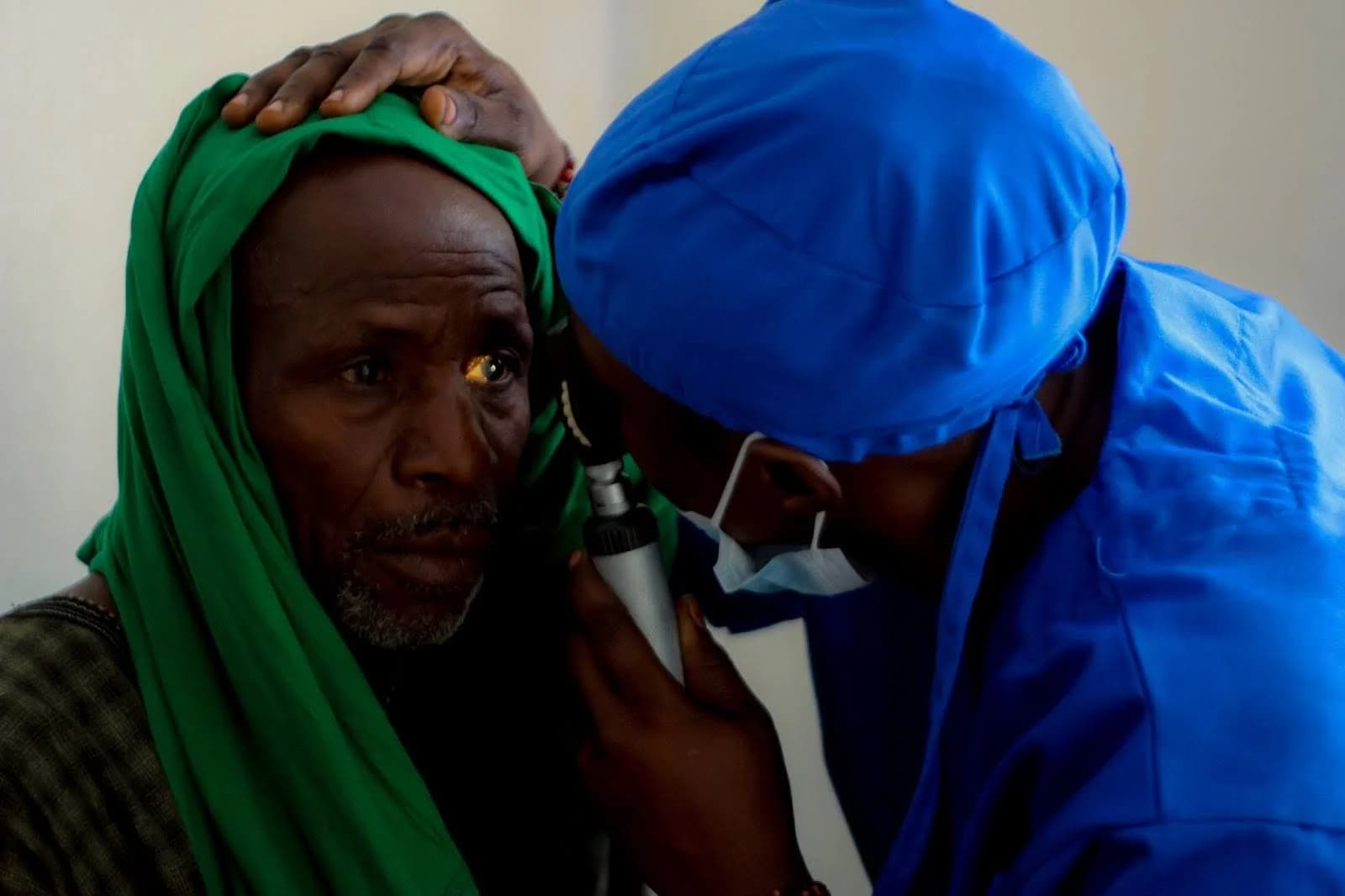
Why Do So Many People Go Blind in Low-Income Countries?
Most blindness in low-income countries is treatable. See the latest WHO data, why cataract goes untreated, and how $120 restores sight in Mali.
By Embrace Relief Team · Updated October 19, 2026
The useful part before the long read.
At least 1 billion people worldwide live with vision impairment that could have been prevented or has not been addressed (WHO, 2026).
Distance vision impairment is about four times more common in low- and middle-income regions than in high-income regions (WHO).
Cataract causes distance vision impairment or blindness for 94 million people, and 1 in 2 people who need cataract surgery cannot access it (WHO).
In Mali, about 80,000 cataract surgeries are needed each year, but fewer than 10,000 are performed. $120 sponsors one surgery through Embrace Relief.
Most blindness in low-income countries is not caused by rare or incurable diseases. It is caused by conditions that are routinely treated elsewhere, above all cataract, combined with poverty and a lack of eye care. This guide explains why avoidable blindness is so common in low-income countries, what the latest World Health Organization data shows, and how Embrace Relief's free cataract surgery program in Mali closes part of the gap.
Why is blindness so common in low-income countries?
Blindness is more common in low-income countries because the conditions that cause it go untreated, not because they are untreatable. The World Health Organization estimates that at least 2.2 billion people have a near or distance vision impairment, and that for at least 1 billion of them the impairment could have been prevented or is still unaddressed. Distance vision impairment is about four times more common in low- and middle-income regions than in high-income regions. The two leading causes, uncorrected refractive error and cataract, are both treatable with glasses or a short operation. Where eye surgeons are scarce, clinics are far away, and families live on very little, these treatable conditions become lifelong blindness. Poverty, in other words, turns a fixable problem into a permanent one.
What is the leading cause of blindness in Africa?
Cataract is one of the leading causes of blindness in Africa and worldwide. A cataract is a clouding of the eye's natural lens. It usually develops slowly with age, and the risk rises with factors such as long-term exposure to sunlight (ultraviolet light), diabetes, eye injuries, and some medications. Children can also be born with cataracts or develop them early. Cataract blindness is different from most other causes of vision loss because it can be reversed: surgery removes the cloudy lens and replaces it with a clear artificial lens. In Embrace Relief's program in Mali, the operation takes about 15 minutes, and 96% of patients regained vision.
| Condition (WHO, 2026) | People with distance vision impairment or blindness | Treatable? |
|---|---|---|
| Cataract | 94 million | Yes — surgery |
| Refractive error | 88.4 million | Yes — glasses or lenses |
| Age-related macular degeneration | 8 million | Can be slowed in some cases |
| Glaucoma | 7.7 million | Can be slowed if detected early |
| Diabetic retinopathy | 3.9 million | Can be slowed if detected early |
What stops people from getting cataract surgery?
Four barriers keep people with cataracts from treatment in low-income countries:
- Cost. Even a modest fee is out of reach for families living on very little. Massarna Diarra, a clothes vendor in Mali, lost her sight and her income because she could not afford the 80,000 FCFA her surgery would have cost.
- Distance. Eye surgeons are concentrated in cities. For rural patients, the trip itself, plus lost work days, can cost more than a family can bear.
- Shortage of specialists and equipment. Many districts have no eye surgeon at all, and clinics that exist are often under-equipped.
- Awareness. Many people believe blindness is simply part of aging. In an Embrace Relief community survey, 57% of people in Mali did not know that cataracts can be cured.
What happens to families when someone loses their sight?
When an adult loses their sight, the effects reach the whole household. Adults often have to stop working, older people become dependent on relatives for daily tasks and face a higher risk of falls, and children may leave school to guide or care for a blind family member. Children who lose their own sight fall behind in school. Nine-year-old Maymuna, from a village outside Bamako, had to leave school because of cataracts until Embrace Relief's mobile health unit identified her condition and arranged free surgery. Restoring sight therefore restores much more than vision: it returns income, independence, and education to entire families.
Cataract blindness in Mali: the gap in numbers
| Indicator | Figure |
|---|---|
| Cataract surgeries needed in Mali each year | About 80,000 |
| Cataract surgeries performed each year | Fewer than 10,000 |
| People in Mali unaware that cataracts are curable (Embrace Relief survey) | 57% |
| Cataract surgeries supported by Embrace Relief | 45,500+ |
| Patients who regained vision | 96% |
Source: Embrace Relief Cure Cataract program data.
How Embrace Relief is closing the gap in Mali
Embrace Relief's Cure Cataract program brings eye care to the communities that need it most. Mobile teams of ophthalmologists, nurses, and volunteers travel to rural villages in Mali, educate communities about cataracts, screen patients, perform surgery, and provide follow-up care with post-operative checks and eye drops. Patients pay nothing. A $120 gift sponsors one surgery and supports screening for about 15 people. Read more about what the $120 sponsorship covers or meet patients in Seeing Again: Cataract Patient Stories from Mali.
Sources
- WHO, Blindness and vision impairment fact sheet (10 February 2026) — https://www.who.int/news-room/fact-sheets/detail/blindness-and-visual-impairment
- Embrace Relief, Cure Cataract program — /cure-cataract
- Embrace Relief, Free Cataract Surgery in Africa (community survey) — /blog/how-to-sponsor-a-free-cataract-surgery-in-africa
Frequently asked questions
What is the leading cause of blindness in Africa?
Cataract is one of the two leading causes of vision impairment and blindness worldwide, together with uncorrected refractive error, and it is a major cause of blindness across sub-Saharan Africa. Unlike many causes of blindness, cataract can be treated with surgery.
Can cataract blindness be reversed?
Yes. Cataract surgery removes the clouded lens and replaces it with an artificial lens. In Embrace Relief's Mali program, 96% of patients regained vision after surgery.
Why don't people in low-income countries get cataract surgery?
The main barriers are cost, distance to eye care, a shortage of eye surgeons, and lack of awareness. WHO estimates that 1 in 2 people worldwide who need cataract surgery do not have access to it.
How can I help prevent blindness?
You can sponsor a cataract surgery in rural Mali through Embrace Relief for $120. The gift supports screening, surgery, and follow-up care for a patient who could not otherwise afford it.